Hydroponic vs organic vegetables: what's the difference, and which should you buy?
Organic and hydroponic answer different questions. One is about inputs and soil; the other is about control. Here's what each label really tells you.
Key takeaways
- Organic is a certification about permitted inputs and soil management. Hydroponic is a growing method without soil.
- Organic farming can still use approved natural pesticides. Hydroponics in a sealed greenhouse can avoid sprays altogether.
- Nutrition depends more on variety, freshness and handling than on organic versus hydroponic.
- In India, certified organic food carries the Jaivik Bharat logo; hydroponic produce is usually sold as pesticide-free instead.
- Freshness is the biggest difference you'll taste, and that comes from a short supply chain.
People often assume hydroponic is a kind of organic, or the opposite of it. It's neither. The two labels answer different questions, and once you see that, choosing gets easier.
What does "organic" mean?
Organic is a set of rules about how food is produced. In India, certified organic food is produced under the National Programme for Organic Production (NPOP) or the Participatory Guarantee System (PGS-India), and packaged organic food sold to consumers is regulated by FSSAI and carries the Jaivik Bharat logo.
The core ideas are:
- No synthetic fertilisers or synthetic pesticides
- Building and protecting soil health
- Approved natural inputs only
Two points are often missed. Organic farming can use approved natural pesticides. And organic crops are grown in open fields or under simple cover, so they face the same weather, pests and contamination risks as any other field crop.
What does "hydroponic" mean?
Hydroponic describes how a plant is grown: without soil, with roots fed a measured nutrient solution. It says nothing on its own about pesticides.
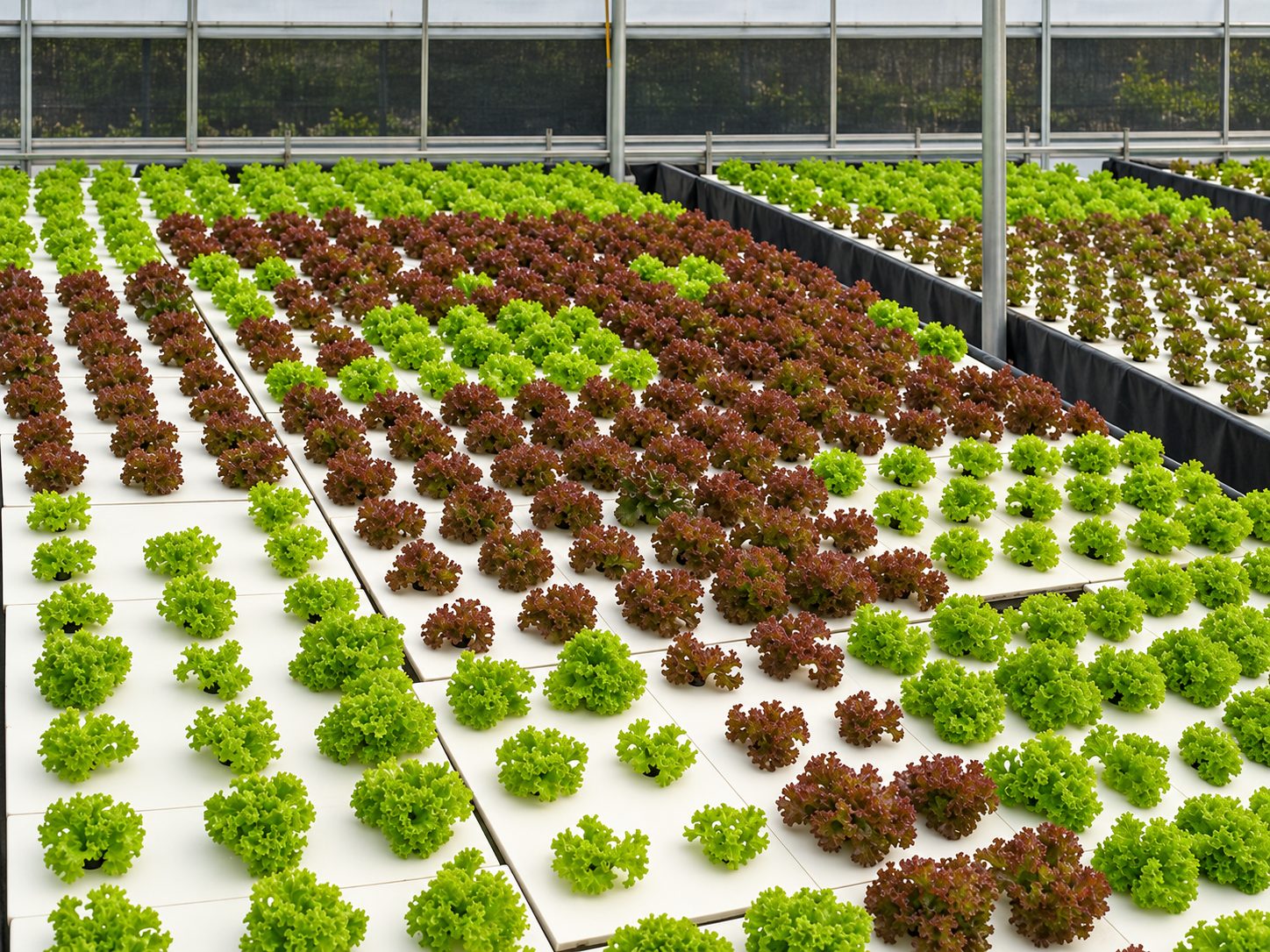
What matters is the environment around it. In a sealed, climate-controlled greenhouse, like the ones we run, pests are kept out with insect-proof netting and managed with biological controls, so sprays aren't needed. That's why we describe our produce as pesticide-free.
Side by side
| Organic | Hydroponic (in a sealed greenhouse) | |
|---|---|---|
| Grown in | Soil, usually open field | Nutrient solution, protected structure |
| Fertiliser | Natural, approved inputs | Measured mineral nutrients |
| Pesticides | Natural, approved pesticides allowed | Avoided through exclusion and biological control |
| Certification in India | NPOP / PGS-India; Jaivik Bharat logo | No specific certification; sold as pesticide-free |
| Weather exposure | High | Low |
| Year-round supply | Seasonal | Largely year-round |
| Soil-borne contamination | Possible | Not applicable |
Is one more nutritious?
Plants absorb the same mineral nutrients, nitrogen, potassium, calcium and so on, whether they come from soil or solution. The things that affect what's on your plate most are variety, how ripe the produce was at harvest, and how long it took to reach you. Lettuce that was cut yesterday will beat lettuce that spent four days in transit, whichever way it was grown.
Which tastes better?
Taste mostly comes down to variety and freshness. Hydroponic farms near cities have an advantage on freshness, because the supply chain is short. Organic produce grown nearby and sold quickly can taste excellent too.
So which should you buy?
- If avoiding pesticide residue is your main concern, pesticide-free hydroponic produce from a sealed greenhouse, or certified organic, both reduce your exposure. Ask the grower how pests are managed.
- If you care about soil health and farming ecosystems, organic directly supports that.
- If you want consistent supply and freshness for a kitchen or a shop, hydroponics close to your city is hard to beat.
Many of our customers buy both. Our greens and herbs reach homes in Delhi, Gurugram and Noida through ChopChop, and we supply restaurants and retailers directly. Ask us anything about how we grow: contact our team.
Frequently asked questions
Is hydroponic food organic?
Not by definition. Organic is a certification about permitted inputs and soil-based farming; hydroponics is a soilless growing method. Hydroponic produce from a sealed greenhouse can be grown without pesticides, but it's usually labelled pesticide-free rather than organic.
Are hydroponic vegetables safe to eat?
Yes. They're grown in clean water with measured mineral nutrients, without soil-borne contamination. Grown in a sealed greenhouse, they can also be produced without pesticide sprays.
Why are hydroponic vegetables more expensive?
The greenhouse, climate control, power and careful handling cost more than open-field farming. In return you get consistent quality, year-round supply and produce grown without sprays.
Sources
Dhruv Khanna
NTU Singapore alumnus. Recognised by Forbes 30 Under 30 Asia (2019) and Forbes India 30 Under 30 (2020) for Triton's work on water-efficient hydroponics.
About Dhruv Khanna